
Mountain rental books, built for ski-town rules and seasons.
A condo in a ski town isn’t a city rental. Lodging taxes stack up, licenses are capped or limited, most of the year’s income lands in a few busy months, and you’re often managing it from somewhere else. Kellcat keeps mountain rental books remotely, property by property.

I’m a mountain lover. I ski, I mountain bike, and I’d rather be outdoors in the mountains than almost anywhere else. That’s a big part of why Kellcat works with ski-town owners: I care about these places, and I want the people who rent homes in them to have clear, calm numbers. I own rental property myself, so I know these numbers from the owner’s side.
Brian Kelly, founder of Kellcat
What makes ski-town rental books harder.
A condo in a ski town runs on different rules and a different calendar than a rental in the city.
Licenses, caps and fees
Many mountain towns cap short-term rental licenses and charge yearly fees. In the Town of Breckenridge, the fee is $756 per bedroom per year (2026).
Lodging tax, town by town
State, county, town and special district taxes can all apply. In Breckenridge they add up to 12.275% on lodging (2026 rate; check the current one). Utah adds transient room taxes, and some resort towns add a resort communities tax.
Most income in a few months
Winter and summer carry the year, while spring and fall are quiet. Without a plan, the shoulder seasons become a cash squeeze.
Payouts, statements and the 1099-K
Payouts, your manager’s statement and the year-end 1099-K rarely match. Kellcat ties all three to the bank, so you know what each unit really made.
HOA dues and assessments
Condo and townhome dues, plus special assessments, that surprise you or your CPA or tax pro if they aren’t tracked.
Owner stays and blocked nights
Your own ski weeks, rented nights and maintenance blocks blur together by year-end unless they’re kept apart.
Short-term, mid-term or long-term?
Town rules keep changing. Your books show what the home nets as a short-term rental today, so you can weigh a mid-term or long-term lease with real numbers.
Renovations vs. repairs
A new deck and a fixed leak aren’t the same on the books. Improvements are kept with dates and invoices, so your CPA or tax pro can treat each one correctly.
Managing from a distance
Front Range and out-of-state owners rely on a manager or co-host on the ground, so the books are how you see what really happened each month.
Rules and lodging tax for your town.
Each guide covers who licenses your rental, the caps, every layer of lodging tax and what it means for your books.
Check the parcel first: many Breckenridge addresses are county, not town. In town, it’s $756 per bedroom a year and 12.275% lodging tax (2026).
Read the guide →ColoradoAspen & SnowmassClassic permits are capped by zone, and renewal runs November 15 to January 14. Lodging tax reaches about 22.35% on Classic permits (2026).
Read the guide →ColoradoVail & Eagle CountyA Vail address isn’t proof you’re in Vail. Town lodging tax is 10.8%, and Eagle County’s rose from 2% to 4% on January 1, 2026.
Read the guide →ColoradoTelluride & Mountain VillageSeparate towns, separate licenses. Telluride limits each owner to two short-term rental units, and you file town taxes monthly, per property.
Read the guide →ColoradoSteamboat SpringsYour zone decides everything: Zone A is unlimited, Zone B is capped and Zone C bans short-term rentals. Lodging tax is 18.4% in the city (2026).
Read the guide →ColoradoCrested ButteTown licenses are capped at 198 and accepted only October 1–31. Lodging tax is about 20.9% in town for 2026.
Read the guide →ColoradoWinter Park & Grand CountyMany Winter Park addresses are really Fraser or the county. Town registrations all expire September 30, and lodging tax in town is 13.2%.
Read the guide →ColoradoEstes ParkTown licenses are capped at 322 in residential zones, with a lottery waitlist and a $1,500 workforce housing fee (2026). Renewal is due January 31.
Read the guide →UtahPark City & Summit CountyMany Park City addresses are in the Snyderville Basin, not the city. Lodging tax is about 14.62% in Park City and 13.12% in the Basin.
Read the guide →UtahHeber ValleyHeber City, Midway and Wasatch County each set their own rules. Midway allows nightly rentals only in its overlay district, which shrank in September 2026.
Read the guide →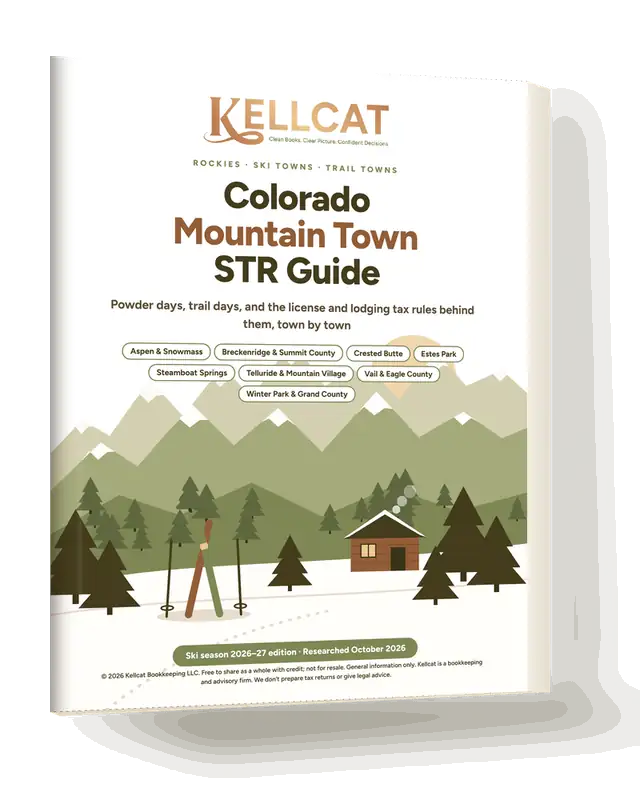
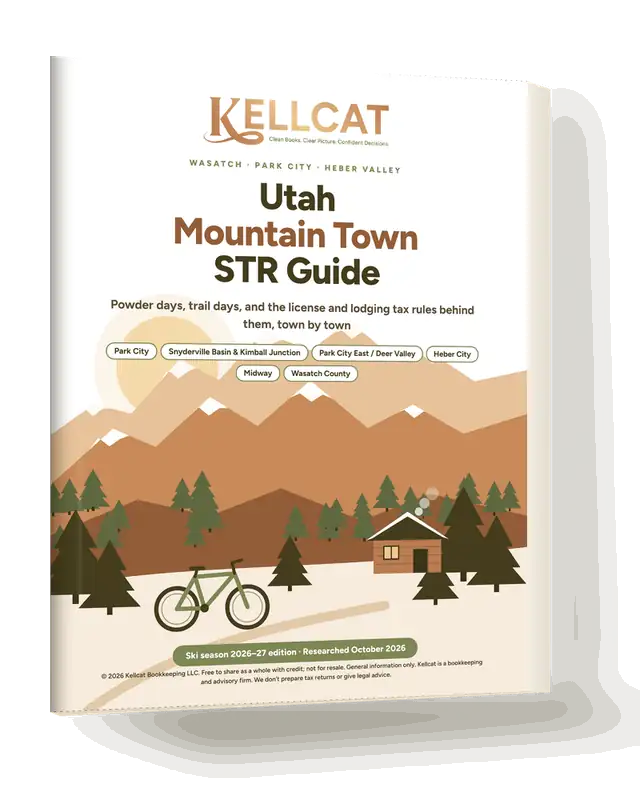
Free Colorado & Utah Mountain Town STR Guides — license + lodging tax for 14 mountain areas
Licenses, caps and every layer of lodging tax for 14 Colorado and Utah mountain areas, in two plain-English PDFs. Pick your state and we’ll email it.
“My books were a complete disaster. Brian from Kellcat helped me clean them up and also showed me which metrics I should be tracking. His knowledge of QuickBooks blew my mind. He showed me stuff I didn’t even know was possible. I would highly recommend working with him.”
Three ways we can help.
Your price is set by the size of your books (LLCs, accounts and monthly transactions). You choose the level, and you can move up any month. Replies within 1–2 business days.
What messy books cost you: CPA hours rebuilding the year from statements · a lender waiting on a rent roll and P&L · months of not knowing which property is losing money.
Tax-Ready Books
Best for a few rentals in one or two LLCs.
Every month closed and matched to your bank and loan statements, so tax time is a hand-off to your CPA or tax pro, not a rebuild.
- Books closed every month for each LLC, matched to your bank and loan statements
- Every transaction tagged to the right property
- Mortgage payments split into principal, interest and escrow
- Partner money in and out recorded
- Your 6 key numbers every month
- A quarterly one-page review with profit by property
- Up to 4 closing statements a year
- Year-End CPA Package included ($450 value)
Portfolio Cash Flow
Best for a growing portfolio, a property manager or several LLCs.
See which property earns and which one quietly costs you, every month, not just at tax time.
- Everything in Tax-Ready Books
- Profit and cash flow for every property, every month
- Property manager statements matched to your bank, so missing rent and extra fees show up the month they happen
- Cash-on-cash return for each property every quarter
Lender & Partner Ready
Best for refinancing, buying more or reporting to partners.
Numbers ready the day a lender or partner asks, plus a cash plan for reserves and repairs.
- Everything in Portfolio Cash Flow
- A Refi Package every quarter ($395 value each): rent roll and 12-month P&L for each property
- A 12-month cash plan for reserves, repairs and loan payments
- A 30-minute review call every quarter
- A report for each partner
Your 6 key numbers: money in, operating costs, cash flow after loan payments, cash runway, what you own minus what you owe, and your best and worst property.
For short-term rentals, every level also includes: Airbnb and Vrbo payouts split into bookings, platform fees, cleaning and taxes collected, plus profit, occupancy and nightly rate for each listing · lodging and sales tax tracked by town · owner stays kept apart from rental nights.
Behind on your books? Monthly prices assume your books are caught up. If they’re not, a one-time cleanup comes first, quoted up front once we’ve seen your books.
Want it all on one screen? Add a live dashboard to any package: cash, profit by property and your key numbers in one place, kept current each month. See the real estate examples → Quoted after your free review.
Airbnb & Vrbo payouts: $75 a listing per month for the first 4, then $50 each, only when the platform pays you directly. No listing fee when a property manager sends one statement.
Working with a property manager?
Your manager runs the bookings; we keep your books. Their monthly statement is matched to what actually hit your bank, with rent, fees and owner payouts in full. There’s no listing fee when a manager sends one statement. Property managers: if your owners need books their CPA can work from, get in touch.
Pick the fit for your properties.
One clear picture across every home, entity and business.
For owners of mountain homes, often more than one, each in its own LLC, alongside an operating business or practice. Kellcat keeps every set of books in step, remotely and discreetly.
- Books by property and LLCSide by side, and as one picture with your business.
- Payouts and statements matchedPlatform payouts and manager statements tied to your bank.
- Lodging tax across townsEach town’s layers tracked, remitted vs. still owed.
- A one-page portfolio summaryEach month, by property and by entity, in plain words.
- A 12-month cash planReserves and repairs planned around the slow seasons, in Lender & Partner Ready.
- White-glove serviceOne point of contact, secure read-only access, careful handling.
Keep your own books with a Starter Kit.
The same tracking Kellcat uses with clients, in Excel or Google Sheets.
Ready to hand it off later? Monthly bookkeeping picks up where the kit leaves off. Compare packages ↑
Planned around the mountain calendar.
- Winter: your peak, set aside reserves while bookings are strong
- Spring shoulder season: low bookings, planned spending
- Summer: a second season in many towns
- Fall shoulder season: maintenance and upgrades before winter
- Property tax, HOA, insurance and license renewal dates on the calendar
Four steps, all remote.
- Find your fit in a few quick questions, or book a free Discovery Call on Google Meet.
- Proposal in writing, with your package and any catch-up work.
- Set up by property and LLC, with past statements matched where needed. Documents are requested once, through your secure client portal.
- Books closed every month, with profit by property and a cash plan for the seasons ahead.
Not ready for monthly bookkeeping? Start with the $97 Starter Kit, have Kellcat review your own books for $199 a month, or get a one-time Books Setup for $797. Before tax time, the Year-End Books Check is $395.
Mid-term or long-term rentals too? Monthly and yearly leases run on rent rolls, deposits and lease terms rather than nightly stays. See rental bookkeeping, or track them yourself with the LTR + BRRRR Starter Kit. Renting outside the mountains? See short-term rental bookkeeping.
Mountain rental bookkeeping questions.
Do you work with owners outside the Denver area?
Yes. Kellcat is based in Littleton, Colorado, and works remotely with short-term rental owners in Colorado and Utah mountain communities through secure access to your accounting software, email and Google Meet.
My property manager handles everything. Why do I need a bookkeeper?
Your manager runs the rental. Your books still need to tie their statements to your bank, record every fee and owner charge, track owner use, and give your CPA or tax pro clean numbers by property.
Why track owner stays?
Personal use of a rental property can affect how it’s taxed, so your CPA or tax pro needs accurate counts of rented nights and owner nights. Kellcat keeps them separate all year.
Do the platforms or my property manager file lodging taxes for me?
Sometimes, depending on the town and how you book. Some towns have agreements with Airbnb and Vrbo, and some managers file for owners who rent only through them, but that isn’t true everywhere or for every tax. Kellcat records what was collected and filed for you, so you and your CPA or tax pro can confirm nothing is missed.
How do you handle HOA special assessments?
They’re recorded separately from regular dues and tracked by property, so your CPA or tax pro can decide how they should be treated.
Do you work with Utah properties?
Yes. The work is remote, so Utah resort-area properties get the same monthly close, with Utah’s own lodging tax layers set up in the books.
Which towns do you cover?
Any Colorado or Utah mountain community, because the work is remote. The town guides above cover ten of the most popular areas, from Breckenridge to Heber Valley.
Can you keep books for several properties in separate LLCs?
Yes. Each LLC can keep its own set of books, and you see every property and entity side by side, plus one combined picture with your business or practice.
Part of Kellcat’s real estate investor bookkeeping.
Before tax time: the Year-End Books Check, $395, checks your year before it goes to your CPA or tax pro. It’s credited if you start other help within 30 days. Find my fit →
More for real estate investors.
Your mountain rental, clear in every season.
Talk it through on a free Discovery Call, or find your fit in a few quick questions.