
Rental property bookkeeping that shows cash flow on every door.
Rent comes in, bills go out, and the bank balance doesn’t tell you which property is carrying the others. Kellcat keeps landlord books by property and by door, ready for Schedule E, your lender and your next refinance.
What landlord books usually look like before Kellcat.
None of these are unusual. Each one quietly throws off your profit by property, your balance sheet or what your CPA files.
Books your CPA can file from without starting over.
Every property is tracked on its own and every expense lands in a category your CPA can map straight to Schedule E.
Income by property
Rent, late fees, pet fees and other income recorded to the property that earned it, not lumped into one account.
Expenses on the right lines
Repairs, insurance, management fees, taxes, utilities, mortgage interest and more, in categories that match the return.
Repairs vs. improvements
Routine repairs kept apart from improvements, with dates and amounts, so your CPA can decide what gets depreciated.
Depreciation records
Purchase price, closing costs and every improvement in one fixed-asset list per property, carried forward each year.
Loans and escrow tied out
Each payment split into principal, interest and escrow, and balances matched to your lender’s statements and Form 1098.
A year-end package
Profit and loss by property, a balance sheet for each entity and a short list of open questions, ready for tax season.
Kellcat keeps the books and doesn’t give tax advice or prepare returns. Your CPA decides how everything is reported.
Cash flow per door, DSCR and the rest, every month.
Your monthly report answers the questions a bank balance can’t: which door is earning, which one needs attention, and how a lender will see the portfolio.
(NOI − debt service) ÷ doorsincome − operating costsNOI ÷ annual debt servicecollected ÷ scheduledoperating costs ÷ incomeloan balance ÷ valueKnow how much of your money is still in the deal.
- All-in cost: purchase, closing, rehab and holding costs tracked to the property from day one
- Rehab budget vs. actual while the work is going on
- The refinance booked properly: old loan paid off, new loan recorded, closing costs and cash back at closing
- Cash left in the deal and cash-on-cash return after the refinance
- Lender-ready reports for the property and the whole portfolio before you apply
One list your lender and your CPA both trust.
- A rent roll by unit: tenant, rent, lease dates and deposit held
- Late and partial payments flagged each month
- Security deposits kept as a liability and matched to the deposits you hold
- Leases ending in the next 60 days, so renewals don’t sneak up
- Property manager statements split into rent, fees, repairs and owner draws
Self-managing? Kellcat works from your bank activity and your lease list instead.
Three levels of help. Pick the one you need now.
Every level is set up by property and quoted in writing after a free review, based on your number of properties, entities and accounts.
Monthly bookkeeping
Your books closed, reconciled and reviewed every month in QuickBooks Online, Xero or Puzzle.
- Every account reconciled monthly
- Income and expenses by property
- Security deposits and loans tracked
- Schedule E-ready year-end package
Books + dashboard
Everything in Clean Books, plus a dashboard you can read in five minutes.
- Cash flow per door and NOI
- DSCR and expense ratio by property
- Rent roll kept current
- A short monthly summary in plain English
Books + cash flow advisory
Everything in Clear Picture, plus forecasting and up to two calls a month before the big decisions.
- Cash flow forecast for the portfolio
- BRRRR and refinance planning
- Buy, hold or sell scenarios
- Up to two calls a month with Brian
Behind on your books? A one-time cleanup comes first, quoted up front.
Start with the kit, then hand it off when you’re ready.
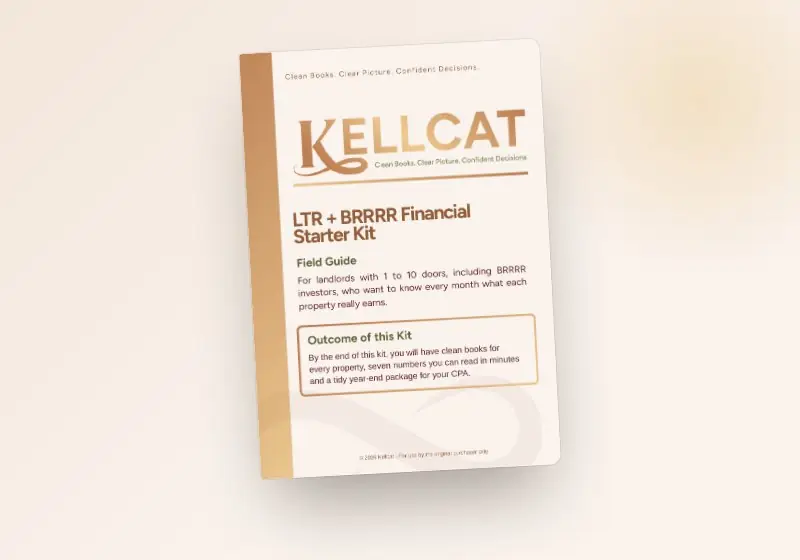
LTR + BRRRR Financial Starter Kit
A 16-tab Excel and Google Sheets tracker for up to 10 rentals, with a full sample year and a 31-page guide. Log rent and bills in about 15 minutes a week and see cash flow per door, DSCR, a rent roll and the math on your last refinance.
Compare every kit on the Starter Kits page.
From a shoebox of statements to books by door.
- Step 1 · Free
Review
A free Books & Numbers Review of your file, or a Discovery Call if you are starting from scratch.
- Step 2 · In writing
Proposal
Your monthly fee and any catch-up work quoted in writing within a week.
- Step 3 · Kickoff
Set up by property
Properties, loans, deposits and past settlement statements set up, with your rent roll built.
- Step 4 · Every month
Books closed
Reconciled books, numbers by door and a Schedule E-ready file for your CPA.
Landlord bookkeeping questions.
What do you need to start bookkeeping for my rentals?
Bank, card and loan statements, your leases and a list of security deposits held, settlement statements for each purchase and refinance, and property manager statements if you use one. You get one checklist through your secure client portal.
Are my books ready for Schedule E?
Yes. Income and expenses are tracked by property and mapped to the lines your CPA uses for Schedule E, with a year-end package for each property. Your CPA still decides how everything is reported and prepares your return.
How do you handle security deposits?
Deposits are recorded as money you owe tenants, not as rental income. When a deposit is returned or applied to unpaid rent or damage, it is recorded that way, so your income and your balance sheet are both right.
Can you track DSCR and cash flow per door?
Yes. Each property shows its net operating income, its loan payments, cash flow after debt service and cash flow per door. DSCR (NOI divided by debt service) is calculated the way most lenders look at it, so you see it before they ask.
Do you track BRRRR deals and refinances?
Yes. Purchase, rehab and holding costs are tracked to the property, then the refinance settlement statement is booked: the old loan paid off, the new loan, closing costs and the cash you got back. You see how much of your money is still in the deal.
Do you calculate depreciation?
No. That is your CPA’s call. Kellcat keeps the records your CPA needs: purchase price and closing costs, every improvement with its date and cost, and repairs kept separate.
I have a property manager. Do I still need a bookkeeper?
Usually, yes. A manager’s statement shows what they collected and paid, not your loan payments, insurance, taxes paid from escrow, or costs you paid yourself. Kellcat combines both into one set of books by property.
Can I start with something smaller?
Yes. The LTR + BRRRR Financial Starter Kit ($97) is a do-it-yourself tracker built on the same categories. When you are ready to hand it off, your kit data makes the switch easy.
Quick answers
Common questions
How do I track rental property income and expenses?
Give every property its own record. Use a separate bank account if you can, tag each rent payment, repair, mortgage payment and improvement to the property it belongs to, and reconcile to your bank statements every month. That shows you cash flow per door and gives your CPA clean, organized records at year end.
- Record rent, late fees and other income by property and by month, and keep security deposits separate from rent.
- Split each mortgage payment into principal, interest and escrow so your numbers match your lender's statements.
- Record repairs and improvements separately, with receipts. Your CPA decides how each one is treated for taxes.
- QuickBooks Online classes or locations, or Kellcat's LTR + BRRRR Financial Starter Kit, make per-property reports easy.
General information, not tax or legal advice.
Know what every door really earns.
Talk it through on a free Discovery Call, or get a free review of your books first.