
Fix-and-flip bookkeeping that shows the real profit on every project.
A closing check isn’t profit, and a big month of rehab spending isn’t a loss. Kellcat keeps flip books by project, from purchase to sale, so you know what each house really made and how the one you’re working on is doing right now.
Signs your flip books are working against you.
Every house is its own set of numbers.
Each flip is set up as a project, and every cost is tagged to it the day it’s paid, so nothing has to be pieced together later.
Purchase
Price, closing costs and prorations from the purchase settlement statement, booked line by line.
Rehab, by category
Demo, framing, electrical, plumbing, finishes and more, so you can see where the budget went.
Holding costs
Loan interest and points, insurance, utilities, property taxes and HOA dues while the project is open.
Selling costs
Commissions, staging, seller credits and closing costs from the sale settlement statement.
Lender draws
Draws recorded as loan money, matched to the draw schedule and your lender’s statements.
Overhead kept separate
Software, marketing, education and the truck stay in business overhead, not inside a house.
Costs wait with the house. Profit shows up at the sale.
Purchase, rehab and holding costs are kept on the balance sheet with the project while the work is going on. When the house sells, the sale price and the full project cost land in the same month, so the profit you see is the profit you made.
Dealer or investor? How the IRS sees your flips changes the tax picture, and that’s a question for your CPA. Kellcat doesn’t give tax advice; it keeps the project records your CPA needs to decide.
Catch the overrun while you can still fix it.
- Your rehab budget set up by category for each project
- Spent vs. budget every month, with overruns flagged
- Days held vs. your plan, because every extra month costs interest
- Cash you’ll still need to finish the work you’ve started
- Profit, ROI and profit per month on every sold flip
What Kellcat needs from you.
- Purchase and sale settlement statements
- Loan documents and lender draw statements
- Your rehab budget, even a rough one
- Contractor invoices or bids for each project
- Which project each card and account pays for, when it isn’t obvious
- Read-only access to your bank, card and loan accounts
Requested once, in one list, through your secure Kellcat client portal.
Three levels of help for flippers.
Every level is set up by project and quoted in writing after a free review, based on how many flips you run and how many entities and accounts you use.
Monthly bookkeeping
Your books closed, reconciled and reviewed every month in QuickBooks Online, Xero or Puzzle.
- Every account reconciled monthly
- Costs tracked by project
- Settlement statements and draws booked
- Year-end project reports for your CPA
Books + dashboard
Everything in Clean Books, plus a dashboard you can read in five minutes.
- Budget vs. actual on every open project
- Profit, ROI and days held on every sale
- Capital tied up and cash available
- A short monthly summary in plain English
Books + cash flow advisory
Everything in Clear Picture, plus forecasting and up to two calls a month before the big decisions.
- Cash flow forecast across projects
- Deal numbers before you make an offer
- Lender and capital planning
- Up to two calls a month with Brian
Run your next flip on the kit first.
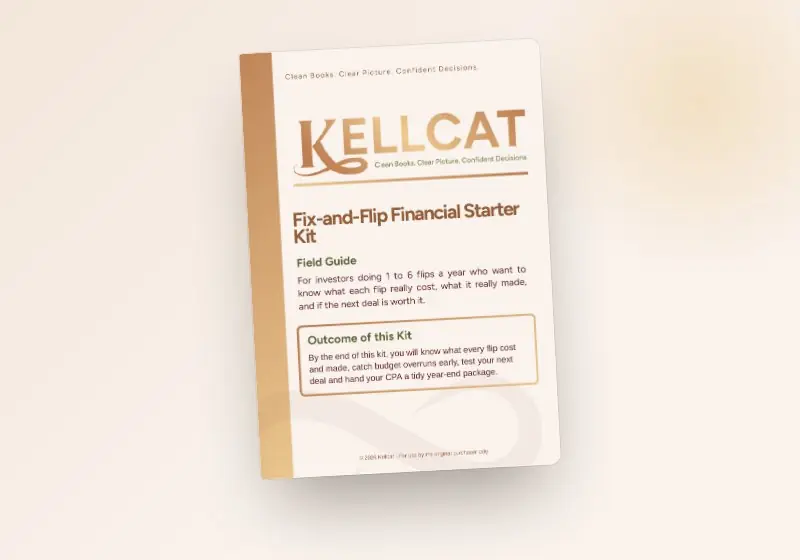
Fix-and-Flip Financial Starter Kit
A 15-tab Excel and Google Sheets tracker for up to 10 projects, with a full sample year and a 28-page guide. Budget vs. actual for every flip, profit and ROI when it sells, and a Deal Analyzer that shows your max offer before you buy.
Compare every kit on the Starter Kits page.
How it starts.
- Step 1 · Free
Review
A free Books & Numbers Review of your file, or a Discovery Call.
- Step 2 · In writing
Proposal
Your monthly fee and any catch-up work quoted in writing within a week.
- Step 3 · Kickoff
Projects set up
Each open and recent flip set up as a project, with past settlement statements and draws booked.
- Step 4 · Every month
Books closed
Reconciled books, budget vs. actual on open projects and real profit on every sale.
“Brian has been very great to work with and help refine our QuickBooks Online. I’m working on flipping houses, and Brian has reviewed our settlement statements to track everything properly as well as provide some insight into how others track costs to optimize reporting and visibility.”Michael S. · Fix & Flip Investor · Google review
Fix-and-flip bookkeeping questions.
Why does my profit look wrong in the middle of a flip?
Because the money you spend on a flip is part of what the house will cost when it sells. Kellcat keeps purchase, rehab and holding costs with the project until the sale, so the profit and loss doesn’t show a big loss while the work is going on and a big gain the month it closes. Your project report shows where each flip stands in between.
How do you track costs for each house?
Every flip is set up as its own project in QuickBooks Online, Xero or Puzzle. Every cost is tagged to the project and grouped into purchase, rehab (by trade if you like), holding and selling costs.
How do you handle hard money and lender draws?
Draws are recorded as loan money, not income. Points, fees and interest are tracked to the project, and the loan balance is matched to your lender’s draw statements. When the house sells, the payoff on the settlement statement closes the loan.
Can I see budget vs. actual while the rehab is going on?
Yes. Your rehab budget is set up by category for each project, and each month you see what has been spent against it, so an overrun shows up while you can still do something about it.
Am I a dealer or an investor for taxes?
That question changes the tax picture, and it is one for your CPA. Kellcat doesn’t give tax advice. What Kellcat does is keep clean records by project so your CPA has what they need to decide.
Do you book settlement statements?
Yes. Every purchase and sale settlement statement is booked line by line: price, closing costs, prorations, loan funding and payoff, seller credits and commissions.
Can I start with something smaller?
Yes. The Fix-and-Flip Financial Starter Kit ($97) is a do-it-yourself tracker built on the same categories, with a Deal Analyzer for your next offer.
Know what every flip really made.
Talk it through on a free Discovery Call, or get a free review of your books first.